The mistake most people make
You bought a new pillow. You tried sleeping on your back. You stretched, drank less coffee, even started yoga. But there is one thing you probably never thought about: the surface you actually lie on for eight hours a night.
That is where the trouble usually starts. A worn-out mattress surface:
- → Spreads weight unevenly across your shoulders and hips
- → Makes it harder to settle into a neutral sleep posture
- → Leaves you restless and less rested in the morning
The tricky part: you usually don't notice — because you got used to it a long time ago.
| Problem | Effect |
|---|---|
| 🛏 Worn-out mattress surface | Uneven pressure on shoulders and hips |
| 🌀 Awkward sleeping posture | Your body can't fully relax overnight |
| 😴 Restless sleep | Mornings that feel less recovered |
When is a mattress really "done"?
Most mattresses are designed to last 7–10 years. Plenty of people sleep on theirs much longer. Four signs that yours has passed its prime:
- 🔍 Visible body indentations — the foam core has given way
- 💤 Stiff in the morning — your shoulders, neck or hips aren't being relieved
- 📐 Sagging edges — the material has lost its structure
- ⏰ Older than 8 years — support and hygiene both drop noticeably
Important: even a mattress that still feels "okay" can ruin your sleep if just the surface layer is worn — and the surface layer is exactly what you can replace on its own.
Where does it hurt? Your sleep position tells you.
How you sleep decides where your body takes most of the pressure — and that is exactly where the quality of your sleep surface matters most.
Shoulders and hips carry the weight. If the surface doesn't give, you toss and turn all night.
The lower back needs support. Too soft and you sink; too firm and your hips take the pressure.
The pelvis pushes down. Without a firm surface, the spine over-extends.
No matter how you sleep, the top layer is what decides comfort and pressure relief. And it is by far the easiest part of your bed to change.
The simplest fix that almost no one talks about
You don't need a new mattress. You don't need to rearrange your bedroom. A good mattress topper is enough.
It sits on top of your existing mattress and immediately changes how you lie:
- → A softer, more adaptive sleep surface
- → More even weight distribution — fewer pressure points
Put it on, lie down, feel the difference. That's the whole process.
What the difference actually feels like
You lie down. The surface gives way exactly where your body needs it to. Nothing digging in. No turning over every twenty minutes. You just let go.

The result?
- → A more neutral sleep posture — less tossing
- → A more even sleep surface — fewer pressure points
- → Better airflow — a cooler bed climate
Which material fits your sleep type?
| Material | Pros | Cons |
|---|---|---|
| Memory foam | Excellent pressure relief | Can trap heat |
| Cold/HR foam | Breathable, durable | Less precise contouring |
| Gel memory foam | Pressure relief + cooling | Higher price point |
In short: soft contouring → memory foam. More support or higher body weight → cold/HR foam. A premium option with cooling → gel memory foam.
How firm should your topper be?
Material on its own isn't enough. The firmness has to be right too.
- → Side sleepers: soft to medium-firm — relieves shoulders and hips
- → Back sleepers: medium-firm to firm — supports the lumbar spine
Tip: a medium-firm topper (around 3 inches of gel memory foam) works for the widest range of sleepers — soft enough to cushion the shoulder, supportive enough for the lumbar spine.
What to look for when you buy
Not every topper lives up to its marketing. Five criteria that actually matter:
- Height of 2–3 inches — thinner than that and you'll feel the mattress through it; much thicker and the slatted base stops working properly.
- OEKO-TEX® + CertiPUR-US® — independent testing for harmful substances and foam quality.
- Washable cover — a zipper and a 105 °F wash is all you need.
- Non-slip underside — otherwise the topper migrates across the bed at night.
- Density ≥ 2.5 lb/ft³ (40 kg/m³) — long-lasting and shape-stable. Higher = more durable.
Use the trial period: 30, 60 or 100 nights — many good brands offer one.
A topper built around support and pressure relief
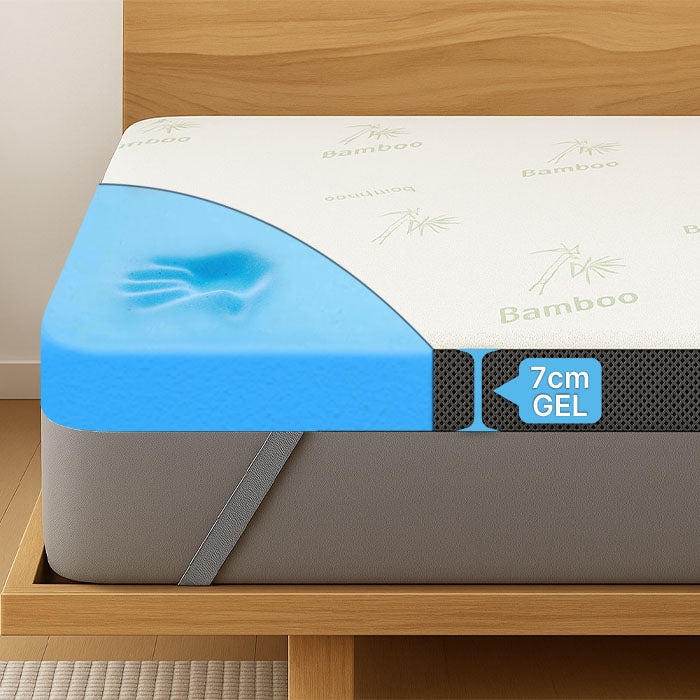
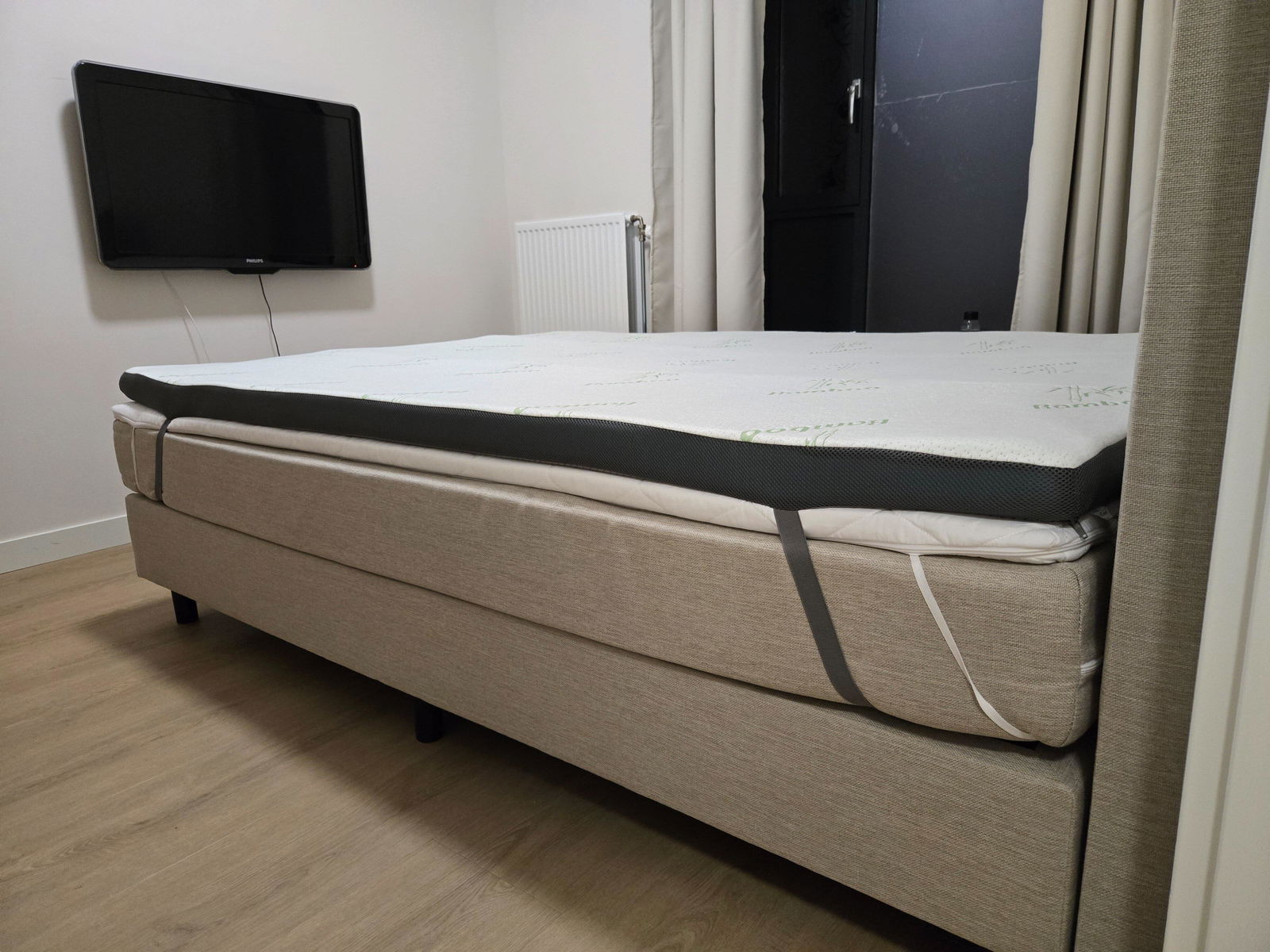
Most toppers are thin afterthoughts. The Dolveo Premium Mattress Topper uses a full 3-inch layer of gel memory foam to add a proper support layer between your body and your existing mattress — designed to help reduce pressure points around the lower back, hips and shoulders and support a more natural spinal alignment overnight.
It's wrapped in a breathable bamboo cover that unzips and goes in the wash — better hygiene, fewer allergens, and a fresher sleep surface week after week.